

Interventions & Supports
Within PWMHS, our team is committed to serve all students regardless of learning type, strengths / weaknesses, and performance ability. As listed within our Staff Handbook, determined by our School Improvement Team (SIT), the following are our four commitments of service to our students...
- We will encourage our students to advance in the areas of character, work ethic, attitude, commitment, and ownership.
- We will provide clear and concise instruction to all of our students, and support our parents as partners in education.
- We will foster inclusion through empathy, equity, problem solving, and relationship building for all students, parents, and staff.
- We will challenge our students to hold themselves accountable in both honesty and integrity, while also being kind and empathetic to others.
That said, as there is never "one size fits all" when it comes to education and the individual abilities / needs within our student body, listed below are a number of resources that showcase different types of resources and supports for those who may need additional assistance.
Testing - 9th, 10th, 11th, and 12th Grade
MSTEP
The MSTEP (Michigan Student Test of Educational Progress) is the statewide summative assessment used in Michigan to measure student proficiency in English Language Arts, Mathematics, Science, and Social Studies based on state academic standards. Schools use M-STEP results to evaluate student learning, guide instructional planning, and meet state and federal accountability requirements. At PWMHS, 11th Graders take the Science and Social Studies tests each Spring. To review PWMHS testing and school data - CLICK HERE.
PSAT 9/10
The Preliminary Scholastic Aptitude Test (PSAT) is a College Board assessment given to students to measure readiness in Reading, Writing, and Mathematics aligned to college and career standards. In Michigan, schools use PSAT 9/10 results to monitor academic growth, identify student strengths and needs, help guide instructional planning and long-term academic pathways, and help qualify students for Dual Enrollment. To review PWMHS' PSAT results and other school data - CLICK HERE.
NMSQT & SAT
Our 11th Grade students take a number of tests throughout the year - including the aforementioned MSTEP. That said, the first of these tests is the National Merit Scholarship Qualifying Test (NMSQT) - the version of the PSAT taken each October that qualifies students for entry into the National Merit Scholarship Program. Then, each April, our juniors take the Scholastic Aptitude Test (SAT) - the assessment most widely used for college entrance. Finally, after the MSTEP, roughly half of our 11th Graders will take their College Board Advanced Placement examinations in May - described below.
Advanced Placement Exams
College Board is a nonprofit organization that develops and administers standardized tests and programs to help students prepare for college and career success. It is best known for the SAT, PSAT / NMSQT, Advanced Placement (AP) courses and exams, and other assessments that guide college admissions and scholarship opportunities. At PWMHS, we offer a number of Advanced Placement courses - each with the potential to earn students college credit. Currently offered each year are courses in Calculus, Computer Science, English Composition, Psychology, and Statistics. PWMHS also offers Advanced Placement Biology and United States History every other year. Students taking Spanish also have an opportunity to take the Advanced Placement Spanish examination.
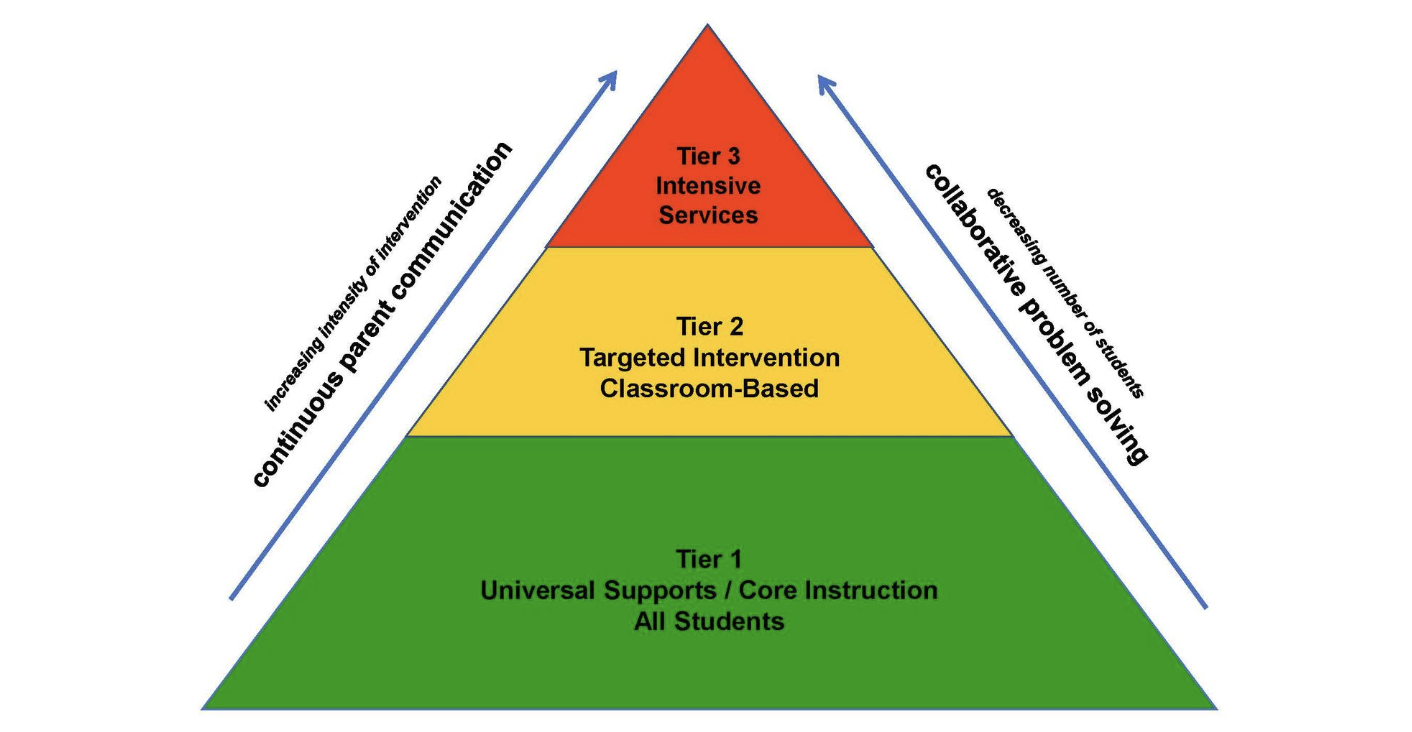
Multi-Tiered Systems of Support (MTSS)
"Tier 1" Supports
Tier 1 refers to the core, universal instruction and supports provided to all students within the Multi-Tiered System of Supports (MTSS). These supports include high-quality, standards-aligned instruction, evidence-based teaching practices, and universal screening designed to meet the needs of most students in the general education setting. At PWMHS, we use the aforementioned assessments to help determine academic intervention and supports in addition to teacher / parent feedback and requests.
"Tier 2" Supports
Tier 2 refers to targeted supports provided to students who need additional assistance beyond core Tier 1 instruction within the MTSS framework. These supports typically include small-group, evidence-based interventions delivered with increased frequency and progress monitoring to address specific academic or behavioral needs. Within our High School, we offer specialized Math classes to students based either upon assessment results or via parent / teacher request. We also offer Peer Tutoring opportunities (by National Honors Society members), an Extended Day program for after school academic support, and credit recovery via our online Credit Recovery - After School Hours (CRASH) program.
"Tier 3" Supports
Tier 3 refers to intensive, individualized supports provided to students with significant or persistent academic or behavioral needs within the MTSS framework. These supports involve highly targeted interventions, increased instructional time, frequent progress monitoring, and may include individualized plans or referrals for special education evaluation. Within PWMHS, we accommodate pupils with specialized student supports (see below), but also proactively work within the framework of our support staff personnel and academic support programs (such as LINKS) to provide one-on-one or small group support within the classroom.
Specialized Student Supports
504 Plan Services
Section 504 of the Rehabilitation Act of 1973 established the first federal civil rights protection for people with disabilities - prohibiting discrimination and requiring reasonable accommodations (such as extended time, preferential seating, or assistive technology) for students whose disabilities substantially limit major life activities without altering academic standards. Unlike an Individualized Education Program (IEP), a 504 Plan does not require specialized instruction but focuses on equity and accessibility within the general education environment. Its purpose is to protect students from discrimination and support their full participation and success in school.
For more information on 504 Plans and Equal Access within Michigan - CLICK HERE.
To request an evaluation for 504 Plan services, contact Jeremy Miller, Student Support Specialist/504 Coordinator - Email
Special Education Services
First passed in 1975, the Individuals with Disabilities Education Act (IDEA) made it a federal law requiring schools to provide free, appropriate public education for children with disabilities. Special education services are a coordinated set of supports and instructional interventions designed to meet the unique learning, behavioral, physical, or emotional needs of students with disabilities. These services are provided in accordance with federal and state laws and are typically outlined in an Individualized Education Program (IEP). Special Education emphasizes access to a "Free Appropriate Public Education" (FAPE) by offering individualized goals, accommodations, modifications, and related services - such as speech therapy, occupational therapy, or counseling - delivered in the least restrictive environment possible. Through collaboration among educators, specialists, families, and students, special education services aim to promote academic growth, independence, and successful participation in school and beyond.
For more information on special education within Michigan - CLICK HERE. To request an evaluation for special education services, contact Anthony Strevett, Special Education Supervisor - [email protected].
English Language Learner (ELL) Services
Driven by court cases such as Lau v Nichols (1974) and laws like the Bilingual Education Act of 1967 and the Individuals with Disabilities Education Act (IDEA) of 1975, English Language Learner (ELL) accommodations are designed to support students who are developing proficiency in English while ensuring they have meaningful access to academic content. These accommodations may include modified instruction, visual supports, language scaffolds, extended time, bilingual resources, and targeted English language development services. The purpose of ELL accommodations is to reduce language barriers - not lower academic expectations - so students can demonstrate their knowledge and skills as they acquire English. By supporting both language development and content mastery, ELL services promote equity, academic success, and full participation in the school community.
For more information on English Language Learners (ELL) provisions and accommodations - CLICK HERE. You may also contact Amy Martin, ELL Coordinator - [email protected].